
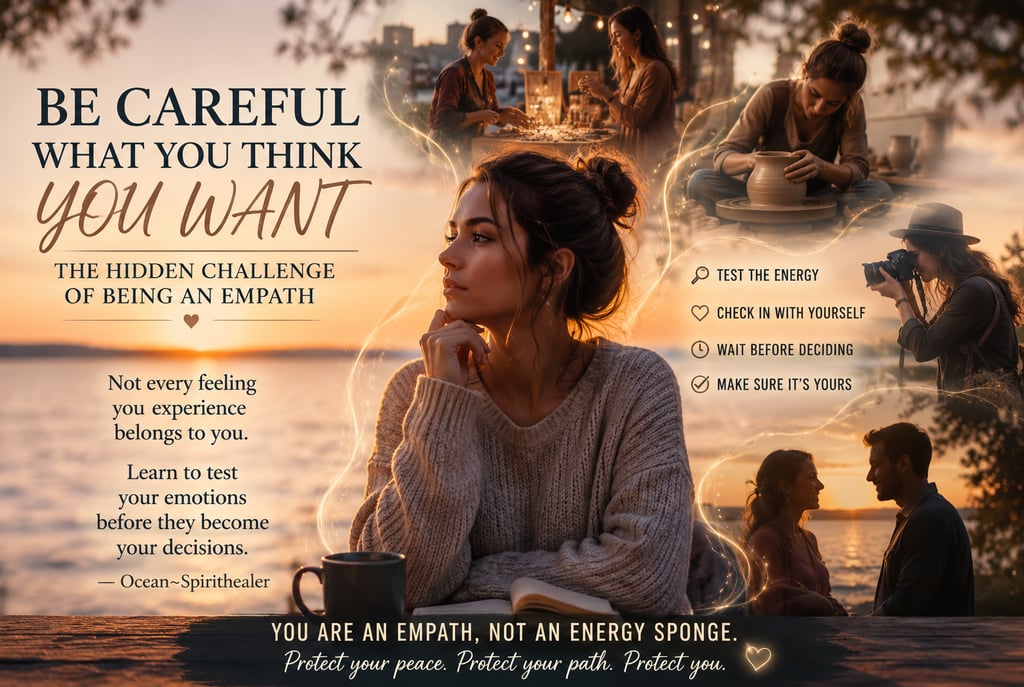
Be Careful What You Think You Want: The Hidden Challenge of Being an Empath
What if some of the desires you believe are yours... actually aren't? This article explores how highly empathic people can unconsciously absorb the emotions, passions, and even romantic interest of others, leading to life decisions that don't reflect who they truly are. Learn why it's important to test your emotions before acting on them and discover practical ways to distinguish your authentic desires from borrowed ones.
Bianca (Ocean) Maria Desmore
6/28/20263 min read
Be Careful What You Think You Want: The Hidden Challenge of Being an Empath
One of the greatest gifts of being an empath is the ability to deeply understand other people. You notice subtle changes in mood, body language, energy, and emotion that many people completely miss. It allows you to connect with others in a way that feels genuine and profound.
But there is another side to empathy that doesn't get talked about enough. Sometimes, what you believe is your desire isn't yours at all. For years, I noticed this pattern in my own life.
I'd walk through a craft fair and suddenly become fascinated with pottery. Fifteen minutes later I wanted to learn woodworking. Then photography. Then candle making. Every booth seemed to awaken a brand-new passion.
At first, I thought I simply had a lot of interests. Eventually, I realized something much more interesting. I wasn't necessarily experiencing my excitement.
I was experiencing theirs.
When someone is genuinely passionate about what they do, their enthusiasm becomes contagious. Psychology actually has a name for this phenomenon: emotional contagion. Humans naturally and often unconsciously absorb the emotions of the people around them. Our brains are wired to synchronize with others, which helps us build relationships and understand one another.
That doesn't mean you're "absorbing energy" in a supernatural sense. It means our nervous systems are remarkably good at picking up emotional cues, facial expressions, tone of voice, excitement, and motivation without us even realizing it. For people who are especially emotionally sensitive, this effect can feel incredibly powerful.
The problem begins when we mistake borrowed emotions for personal truth.
Borrowed Desires
Have you ever walked away from an event convinced you wanted to start a business... Learn a musical instrument...Buy expensive equipment...Move across the country...Or completely change careers? Then three days later...The excitement vanished. Nothing was actually wrong with the opportunity. The feeling simply wasn't yours.
You had borrowed someone else's passion for a moment.
Borrowed Attraction
This can become even more confusing in relationships. Have you ever met someone and immediately believed you had feelings for them? Maybe. But maybe not.
Sometimes the other person is strongly attracted to you. They're thinking about you. They're emotionally invested. They're excited to see you.
Highly empathic people can become so emotionally attuned that they begin confusing another person's emotional experience with their own.
Psychologists distinguish between emotional empathy—actually sharing another person's emotional state—and cognitive empathy, which allows you to understand another person's feelings while still recognizing where they end and you begin. Research suggests people with stronger emotional (affective) empathy may be more vulnerable to emotional contagion and emotional overload if they don't maintain that distinction.
That distinction matters.
Otherwise, you may spend months chasing relationships that never truly reflect your own heart.
Don't Make Major Decisions Inside Someone Else's Emotional Atmosphere
This is one practice that has changed my life. I no longer make important decisions while surrounded by emotionally charged environments. Whether it's a conference...A motivational seminar...A networking event...A craft fair...Or even after spending time with someone I find fascinating...I wait.I leave. I sleep on it.
Then I ask myself one simple question:
Do I still want this when I'm completely alone?
If the answer is still yes after the emotional environment has disappeared...It's probably mine. If it quietly fades away...It probably wasn't.
Test Your Emotions Before You Adopt Them
Before making an important decision, ask yourself:
Would I still want this if I'd never met this person?
Did I desire this before today?
Does this feeling remain after I've spent time alone?
Am I excited about the work itself, or simply inspired by someone else's excitement?
Is this my emotion...or am I simply experiencing someone else's?
Those questions have saved me from making countless decisions based on temporary emotional influence rather than authentic desire.
Your Feelings Matter Too
Empathy is a beautiful gift. But it was never meant to replace your own identity. Being deeply connected to other people's emotions should never disconnect you from your own. The healthiest empath isn't the person who absorbs everything around them. The healthiest empath is the one who can compassionately ask:
"What belongs to you...and what belongs to me?"
Because once you can answer that question honestly...
You'll begin building a life based on your own desires instead of accidentally living someone else's.
And that may be one of the most freeing discoveries you'll ever make.