
Your blog post
Explains the science and reasoning behind The 3-6-9 Meditation Method™, including why it follows the progression of Stabilize → Repair → Release, how believable thinking differs from positive thinking, and how breathing, the nervous system, the Reticular Activating System (RAS), and intentional affirmations work together to support lasting personal transformation. The article also clarifies the role of Solfeggio frequencies as supportive tools rather than magical solutions and introduces the neurological philosophy behind the method.
3-6-9 METHOD
Bianca (Ocean) Maria Desmore
7/27/20264 min read
The 3-6-9 Meditation Method™
Why I Don't Start with Positive Thinking
There is no shortage of meditation techniques available today. Some promise instant manifestation. Others encourage positive thinking, visualization, or repeating affirmations until they supposedly become reality. While many of these practices can be beneficial, I believe they often overlook one critical question.
What happens when your brain doesn't believe what you're telling it?
If you've ever repeated, "I am healthy," while feeling sick... "I am wealthy," while worried about paying bills... or "I am confident," while filled with self-doubt, you've probably noticed something. Your subconscious mind pushes back. Not because affirmations don't work. Because unbelievable affirmations create internal resistance.
This is why I developed The 3-6-9 Meditation Method™.
Rather than asking your brain to believe something it currently rejects, the method follows a sequence that works with the nervous system instead of against it.
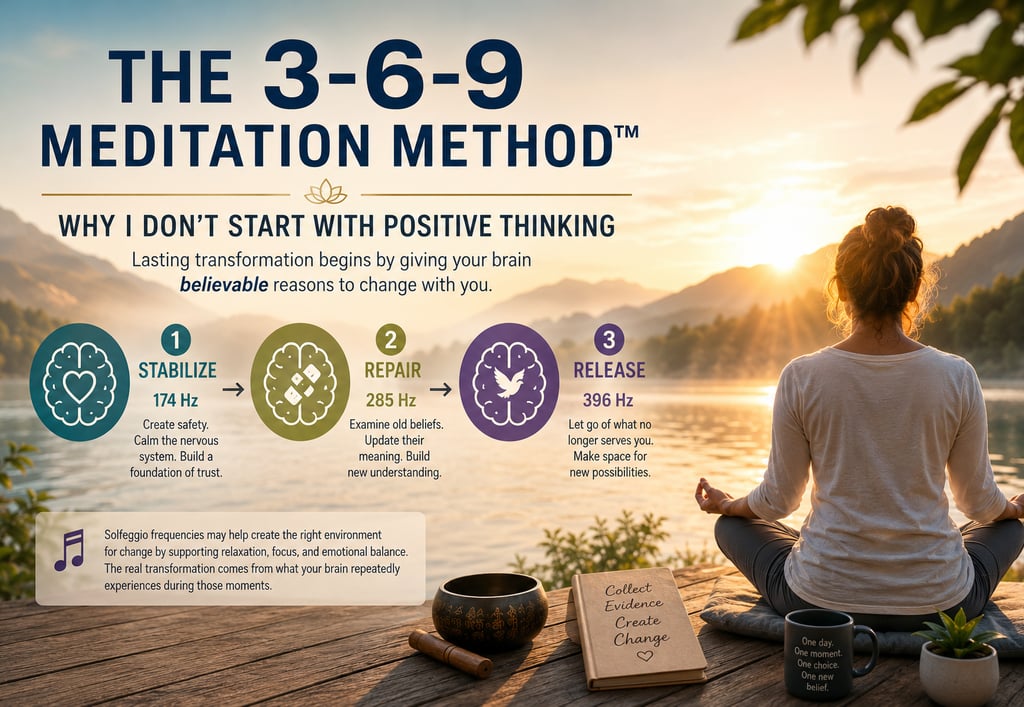
The goal isn't to force belief. The goal is to make belief possible. The method is built around three neurological stages that I call Stabilize, Repair, and Release.
Each stage uses a different Solfeggio frequency alongside guided meditation designed to support a specific mental objective.
Whether Solfeggio frequencies themselves have unique biological effects remains an area of ongoing discussion and research. Some people report meaningful benefits, while current scientific evidence is still limited. What is well established, however, is that sound influences mood, breathing, heart rate, attention, and relaxation. By pairing calming music with intentional mental training, we create an environment that helps the brain become more receptive to change.
That distinction is important. I don't view frequencies as magic. I view them as environmental tools that may help create the conditions necessary for learning new patterns. The real transformation comes from what your brain repeatedly experiences during those conditions.
The first stage is Stabilize, represented by 174 Hz.
Before the brain is willing to accept new ideas, it first needs to feel safe enough to stop defending old ones.
A person living in survival mode is constantly scanning for danger. Their nervous system is focused on protection, not growth. Trying to convince that brain that everything is wonderful often creates even more resistance because the subconscious immediately searches for evidence that contradicts the statement.
That is why my morning meditation begins with breathing. Not affirmations.
Breathing changes physiology. As breathing slows, muscles relax. The jaw unlocks. The shoulders lower. Heart rate gradually decreases.
The nervous system receives repeated signals that this moment is different from the last. Only after creating this calmer internal environment do I begin introducing affirmations. Even then, you'll notice something different. I rarely tell people they already possess everything they desire. Instead, I encourage them to collect evidence.
Evidence is believable.
When I say,
"Today, I will collect evidence that health flows through me."
or
"Today, I will notice opportunities I may have overlooked."
The brain doesn't have to argue. It simply begins searching. This is where neuroscience becomes fascinating.
The Reticular Activating System, often called the RAS, acts as the brain's filtering system. Every second, your senses receive far more information than your conscious mind could ever process. The RAS decides what deserves your attention based largely on what your brain believes is important.
If you constantly tell yourself life is unfair, your brain becomes remarkably efficient at finding evidence that supports that conclusion. If you intentionally begin looking for evidence of opportunity, kindness, progress, or growth, your attention gradually shifts toward noticing those experiences more often.
The world hasn't necessarily changed. Your perception has. And perception influences behavior. Behavior influences outcomes. Over time, outcomes reinforce belief. This is how believable thinking slowly replaces limiting thinking. The second stage of the method is Repair, represented by 285 Hz.
Once stability has been established, the brain becomes more capable of examining old beliefs without becoming overwhelmed by them.
Repair isn't about pretending painful experiences never happened. It is about updating the meaning we've attached to them. Many of the beliefs we carry into adulthood were perfectly logical conclusions for a younger version of ourselves.
A child who was constantly criticized may conclude, "Nothing I do is good enough." A child who experienced abandonment may conclude, "People always leave." A child forced into survival may conclude, "Rest is dangerous." These beliefs once served a protective purpose. The problem isn't that they existed. The problem is that many continue operating decades after the original danger has disappeared.
Repair means giving the adult brain permission to question whether those conclusions are still accurate today. The final stage is Release, represented by 396 Hz. Notice I didn't say "erase." We cannot erase experience. Nor should we want to. Every experience contributes to wisdom.
Release means letting go of the emotional weight attached to beliefs that no longer serve us. It means recognizing that our past helped shape us without allowing it to permanently define us. Identity changes when evidence changes.
Eventually, the affirmations that once felt impossible become believable because your own experiences begin supporting them. This is why I don't ask people to lie to themselves. I ask them to become investigators. Every day, collect one small piece of evidence. One peaceful moment. One healthy choice. One opportunity. One kind interaction. One act of courage.
Those small moments become new neurological data. New data creates new expectations. New expectations create new behaviors. New behaviors create a new identity.
The 3-6-9 Meditation Method™ isn't about escaping reality. It is about training your brain to recognize possibilities it previously ignored. It isn't about pretending life is perfect. It is about becoming someone who can respond to life with greater calm, greater awareness, and greater intention. Positive thinking may inspire us for a moment. Believable thinking transforms us for a lifetime. That is why every meditation I create follows the same simple progression.
First, stabilize the mind.
Then repair the beliefs.
Finally, release what no longer belongs.
Because lasting transformation doesn't begin with convincing yourself that everything has changed.
It begins by giving your brain believable reasons to change with you.