
Train Your Brain Before the World Trains It
Blog Description: Learn how to intentionally organize your mind each morning using gratitude, neuroscience, the Reticular Activating System (RAS), Chain Creation Theory, and the philosophy of Remember Your Future and Create It to move beyond survival mode and begin creating a life of purpose and possibility.
HEALING SURVIVAL MODE
Bianca (Ocean) Maria Desmore
6/25/20264 min read

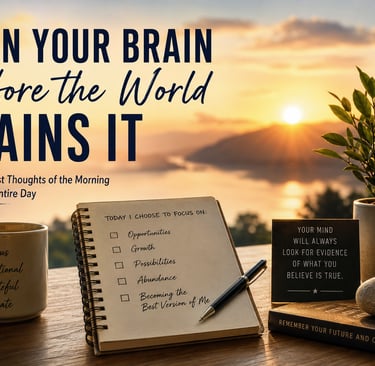
Train Your Brain Before the World Trains It
Why Your First Thoughts of the Morning Shape Your Entire Day
Most people lose control of their day within the first five minutes of waking up—not because something terrible happened, but because they unknowingly allow yesterday's problems to become today's instructions. Before they even leave bed, they remember the bills, the responsibilities, the arguments, the deadlines, and everything that feels unfinished. Their nervous system immediately receives the message: We're surviving again today.
Your brain takes that message seriously.
This isn't simply a matter of positive thinking. It is rooted in neuroscience. Every second, your brain receives millions of pieces of information from your environment. Since it cannot consciously process all of them, it relies on a built-in filtering system known as the Reticular Activating System (RAS). This system determines what deserves your attention based largely on what you repeatedly think about, believe, and expect.
If you begin your day expecting stress, your brain starts searching for stressful situations. If you expect rejection, you notice every sign that appears to confirm that expectation. If you believe opportunities are scarce, your mind naturally overlooks possibilities that don't fit your existing belief system. Your brain isn't trying to sabotage you—it is trying to remain consistent with the instructions you continuously provide.
This is why your morning routine matters far more than most people realize.
Before checking your phone, reading emails, scrolling through social media, or listening to the news, your mind is waiting for direction. The first thoughts you intentionally choose become the search criteria your RAS uses throughout the day. Instead of allowing obligations to organize your thinking, organize your thinking before facing your obligations.
One of the most effective ways to accomplish this is through intentional gratitude. Most people view gratitude as appreciation for what they already possess. While that certainly has value, gratitude can also be directed toward what you are intentionally creating. Rather than focusing exclusively on your current circumstances, begin appreciating the opportunities, relationships, health, peace, and abundance you are working toward.
Instead of saying, "I hope things get better," begin your morning with statements such as, "I'm grateful that new opportunities continue finding me. I'm grateful my nervous system becomes calmer every day. I'm grateful that healthy relationships are becoming my standard. I'm grateful that financial stability is becoming my normal."
Notice the difference.
You are not pretending your current reality doesn't exist. You are teaching your brain what deserves its attention. Once your mind accepts those statements as important, your Reticular Activating System begins searching your environment for evidence that supports them.
This concept aligns naturally with what I call Chain Creation Theory. Through years of observation, I noticed that many people living in survival mode continuously create new jobs, businesses, relationships, hobbies, and identities. The issue isn't a lack of talent or ambition. The problem is that the nervous system has learned to associate constant movement with safety. As long as survival remains the operating system, the brain continues searching for evidence that survival is necessary.
Breaking that cycle begins by changing the instructions you give your mind.
This also connects with my philosophy of Remember Your Future and Create It. While neuroscience clearly demonstrates that visualization influences attention and behavior, my personal interpretation goes one step further. I believe our future self continually communicates with us through our desires, inspirations, curiosities, and the things we feel inexplicably drawn toward. Whether someone views this spiritually, psychologically, or simply as an exercise in intentional visualization, the practical application remains the same: when you consistently focus on the person you are becoming, your present decisions begin aligning with that future.
Instead of asking yourself, "What happened to me yesterday?" begin asking, "What would the future version of me notice today?"
That single question shifts your attention away from survival and toward possibility.
If your future self is financially secure, what opportunities would they recognize today? If your future self has healthy relationships, how would they communicate today? If your future self is confident, how would they carry themselves today? By asking better questions, you give your brain a new assignment.
Research consistently shows that the questions we ask ourselves influence the information our brain retrieves. Questions such as "Why does nothing ever work out?" encourage the mind to produce evidence supporting failure. Questions such as "Where is today's opportunity?" encourage the brain to notice possibilities that may have previously gone unnoticed.
This is why your mornings should become intentional rather than reactive.
A simple routine can dramatically influence how your brain processes the rest of the day. Before leaving bed, take three slow, deliberate breaths and remind yourself that this moment is safe. Next, identify five things you're genuinely grateful for that are developing in your life, even if they have not fully arrived yet. Then ask yourself, "What would the future version of me focus on today?" Choose one emotional state you want to carry throughout the day—peace, confidence, curiosity, gratitude, or calm—and intentionally practice feeling it before circumstances attempt to dictate your emotions. Finally, ask your brain one empowering question, such as, "What opportunities can I recognize today?" or "Where is abundance already showing up in my life?"
Your brain loves questions because questions become assignments.
Perhaps one of the most overlooked habits is protecting the first thirty minutes of your morning. Avoid immediately consuming news headlines, social media feeds, arguments, or other people's problems. Your mind is incredibly impressionable immediately after waking. Whatever enters first often establishes the emotional tone for the hours that follow. Think of it as protecting your operating system before installing the day's software.
Over time, something remarkable begins to happen.
As your Reticular Activating System repeatedly notices opportunities instead of obstacles, solutions instead of limitations, and evidence of progress instead of proof of failure, your beliefs begin changing naturally. You are no longer forcing yourself to think positively. You are collecting enough real-world evidence to support a healthier perspective.
Your brain is always collecting evidence. The only question is whether you're instructing it to collect evidence for survival or evidence for growth.
Every morning, you have an opportunity to decide which reality your brain will spend the day searching for. Before the world tells you what deserves your attention, decide for yourself. Introduce your mind to the future you are intentionally creating. Teach your Reticular Activating System what success looks like. Allow your nervous system to experience safety before it experiences responsibility.
Because the life you consistently focus on is often the life your brain begins helping you build.
Your future begins with your first thought.