
Trauma Isn't Always Abuse: The Invisible Experiences That Shape Us
Not every emotional wound comes from abuse. Sometimes seemingly harmless jokes, repeated fear, humiliation, or emotional unpredictability teach the nervous system that the world isn't safe. In this article, Bianca Ocean Desmore explores how everyday experiences can shape lifelong patterns and why emotional safety matters in parenting, relationships, friendships, and beyond through the lens of The Chain Creation Theory™.
TRAUMA PREVENTION
Bianca (Ocean) Maria Desmore
7/10/20263 min read
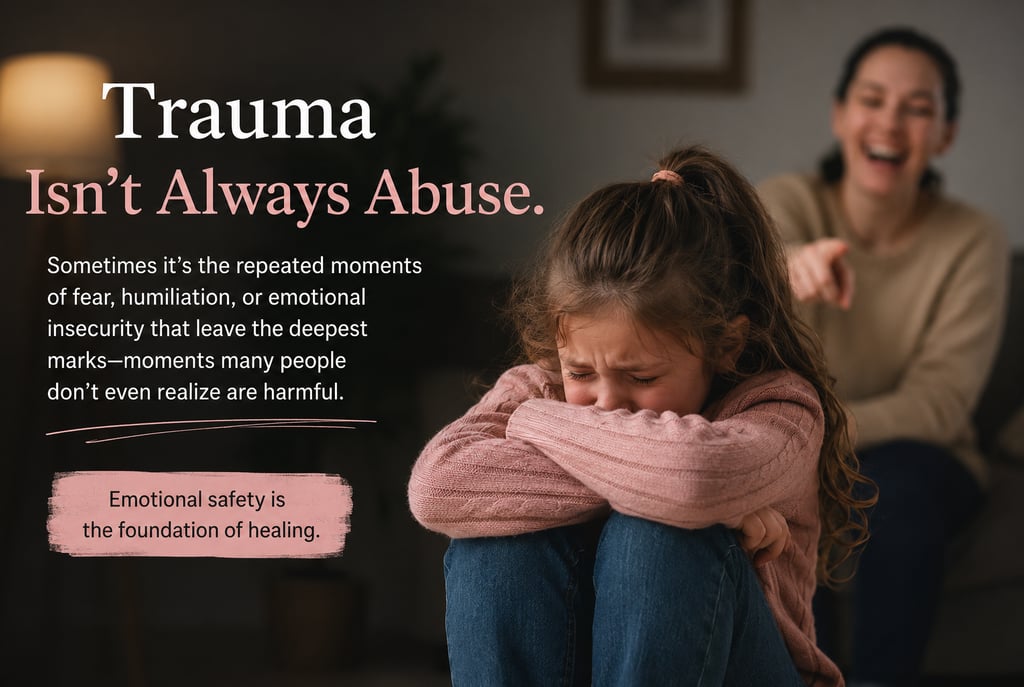
Trauma Isn't Always Abuse
When most people hear the word trauma, they immediately think of physical abuse, neglect, violence, or other extreme events. While those experiences can certainly be traumatic, they are not the only experiences capable of leaving a lasting imprint on the human nervous system. Trauma is not always about the severity of an event. It is often about how safe—or unsafe—a person feels while experiencing it and whether they have the emotional support needed to process it afterward.
This is why I believe we need to rethink the way we talk about trauma. Trauma isn't always abuse. Sometimes it develops through repeated experiences of fear, humiliation, unpredictability, rejection, or emotional insecurity. These experiences may appear harmless to the person creating them, but they can become meaningful to the person living through them.
One trend that has become increasingly popular on social media perfectly illustrates this concern. Videos of parents intentionally frightening their children, pretending to abandon them, convincing them that something precious has been destroyed, or creating elaborate pranks have accumulated millions of views. The comments are often filled with laughing emojis and people calling the videos hilarious. Yet when I watch many of these clips, I don't see comedy. I see genuine fear in a child's eyes. I hear panic in their voice. I watch a nervous system responding to what it believes is a real threat.
The child does not know the situation is staged. In that moment, they are not thinking like an adult who understands the joke will soon be revealed. They are reacting with the emotional and biological systems they have available at their age. Their heart races, stress hormones increase, and their brain begins trying to answer an important question: "Am I safe?"
Does that mean every prank creates lifelong trauma? No. Human beings are remarkably resilient, and many children recover quickly from isolated frightening experiences. However, that does not mean these moments are meaningless. When fear, humiliation, or emotional uncertainty become repeated forms of entertainment, they also become repeated lessons. Children learn about trust, safety, relationships, and the predictability of the people around them through thousands of everyday experiences—not only through major life events.
One of the greatest misconceptions about trauma is the belief that good intentions automatically eliminate harm. Most parents genuinely love their children. They are not trying to damage them. Many are simply repeating behaviors they experienced growing up because no one ever taught them to question whether those behaviors were healthy. If something was normalized during our own childhood, we rarely stop to ask whether it should continue into the next generation.
This idea extends far beyond parenting. Adults experience similar patterns in friendships, romantic relationships, workplaces, and families. Someone repeatedly uses embarrassment as humor. A partner threatens to leave during arguments just to make the other person chase them. Friends deliberately provoke jealousy because they think it is funny. A manager publicly humiliates employees believing it will motivate them. None of these situations necessarily fit the traditional definition of abuse, yet each has the potential to teach a nervous system that emotional safety is uncertain.
That is why I often say that trauma isn't always abuse. Sometimes it is the repeated absence of emotional safety.
Within The Chain Creation Theory™, I describe how recurring behavioral patterns begin with what I call the "first link." Long before someone becomes a chronic people-pleaser, perfectionist, controller, overachiever, isolator, or someone who constantly starts over, the brain has been collecting experiences that shape its expectations of the world. Those experiences become the foundation upon which future beliefs and behaviors are built. The visible behavior is rarely the beginning of the story. It is simply the latest link in a chain that started much earlier.
If we truly want to help future generations, we should not only ask whether we are providing food, shelter, and education. We should also ask whether we are providing emotional safety. Are we teaching children that the people they trust will protect them, or are we unintentionally teaching them that love sometimes comes wrapped in fear? Are we creating moments they will laugh about together years from now, or moments their nervous system quietly stores as evidence that the world is unpredictable?
The purpose of asking these questions is not to create guilt or shame. Blame rarely changes behavior. Awareness does. Parents cannot change what they do not recognize. Friends cannot improve relationships if they believe emotional manipulation is simply part of human interaction. Partners cannot build secure relationships while confusing fear with love or control with commitment.
The more we understand how the nervous system learns, the more intentional we can become in the experiences we create for the people we love. We have the opportunity to raise children who feel emotionally safe, build relationships based on trust instead of uncertainty, and create communities where people no longer mistake fear for humor.
Trauma isn't always abuse. Sometimes it is simply a repeated experience that teaches the brain the world is less safe than it truly is. If we become aware of those moments, we have the power to stop creating them—and perhaps prevent countless invisible wounds before they ever become the first link in someone's chain.