What If the Glass Is Gone...But Your Brain Doesn't Know It?
The famous Pike Experiment may be more myth than science, but the psychology behind it is very real. In this article, Bianca Ocean Desmore explores the science of learned helplessness, credits the groundbreaking work of Martin Seligman and Steven Maier, and introduces how The Chain Creation Theory™ expands the conversation by explaining why some people don't give up—they adapt. Discover why your survival strategy may have become your identity and how finding your First Link can help you finally fix the chain.
Bianca (Ocean) Maria Desmore
7/13/20264 min read
What If the Glass Is Gone...But Your Brain Doesn't Know It?
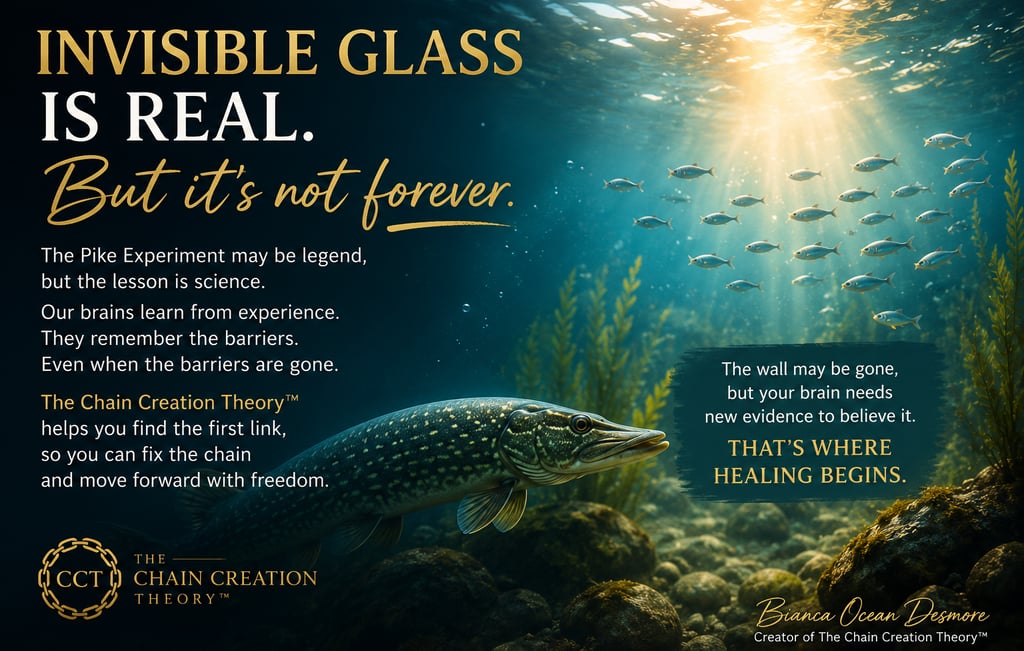
Have you ever heard the story about the hungry pike? It's one of the most widely shared stories in personal development. According to the popular version, scientists placed a hungry pike in one side of a tank and small fish on the other, separated by a clear glass divider. The pike repeatedly slammed into the invisible barrier trying to reach its meal. After enough failed attempts, it eventually gave up. The dramatic ending claims that the divider was later removed, the tiny fish swam freely around the pike, and yet it ignored them completely because it had become convinced the barrier still existed.
It's an unforgettable story. Unfortunately, it probably never happened exactly that way.
While researchers such as Karl Möbius in the 1870s and Raymond Triplett in the early 1900s did conduct experiments involving predatory fish and glass partitions to study learning and behavior, there is no verified scientific evidence that a pike was left surrounded by food and simply starved because it "remembered" the glass. Somewhere over the decades, the story evolved into one of the most powerful motivational metaphors ever told. Even though the ending appears to be legend, the lesson resonates because it feels true.
The reason it feels true is because most of us have experienced our own version of invisible glass. Maybe yours was rejection. Maybe it was repeated failure. Maybe it was growing up believing you weren't good enough, smart enough, or worthy enough. Maybe it was a relationship that taught your nervous system that love wasn't safe. Whatever the experience, your brain learned from it. Long after the actual barrier disappeared, your nervous system continued responding as though it were still standing in front of you.
That idea isn't just philosophy. It has a solid scientific foundation. In the late 1960s, psychologists Martin Seligman and Steven Maier conducted a series of experiments that led to what became known as learned helplessness. Their research demonstrated that when animals repeatedly experienced situations they could not control, many eventually stopped trying to escape, even after escape later became possible. Their work has profoundly influenced modern psychology and has helped researchers better understand depression, trauma, chronic stress, and motivation.
I have tremendous respect for the work of Seligman and Maier because it explained something that countless people experience after prolonged adversity. However, as I began studying survival patterns in myself and hundreds of others, I noticed something that their research wasn't designed to answer. Not everyone stops trying.
In fact, some people never stop trying at all. Instead, they adapt. That observation became the foundation for The Chain Creation Theory™.
Rather than asking why some people become passive, I began asking why other people seem to become even more active after trauma. Why does one person withdraw while another starts business after business? Why does one person surrender while another becomes obsessed with perfection? Why does one person isolate while another spends every waking moment taking care of everyone else? Why does someone stay constantly busy because sitting still somehow feels more uncomfortable than exhaustion?
Those people aren't helpless. Their nervous systems are still fighting for safety. They're simply using different survival strategies.
This is where I believe The Chain Creation Theory™ extends the conversation surrounding learned helplessness. Learned helplessness explains one predictable response to uncontrollable experiences: people may eventually stop trying because they believe nothing they do will change the outcome. The Chain Creation Theory™ proposes that another group of people responds differently. Instead of giving up, they unconsciously develop specific survival identities that help them feel safer in the world.
Through years of observation, I identified six recurring patterns that I call the Chain Creator™ Types. The Builder creates. The Caretaker rescues. The Perfectionist improves. The Controller organizes. The Isolator withdraws. The Busy Bee never stops moving. Although these behaviors appear completely different on the surface, I believe they often serve the same underlying purpose: helping the nervous system regain a sense of safety and control.
That's an important distinction. From my perspective, the opposite of helplessness isn't necessarily healing. Sometimes it's overcompensation. Sometimes it's relentless productivity. Sometimes it's perfectionism disguised as excellence. Sometimes it's creativity disguised as purpose. The person looks successful on the outside while their nervous system is still operating from survival mode.
Think about the entrepreneur who continually launches new businesses but struggles to remain in one place long enough to enjoy success. People usually call that ambition. It certainly can be. But what if, for some individuals, creating has become the safest place their nervous system knows? What if constantly building something new isn't simply a personality trait but a survival strategy?
The same question applies to relationships. People often ask, "Why don't they leave?" I find myself asking a different question: "What feels even more dangerous than staying?" Once you begin examining the first experiences that shaped a person's nervous system, behaviors that once seemed irrational often become remarkably understandable.
I've often said that most people don't have seven unrelated problems. They have one repeating pattern wearing seven different outfits. Yes, patterns apparently have an excellent wardrobe. The point isn't to criticize ourselves for adapting. Adaptation is one of the greatest strengths of the human brain. The problem arises when yesterday's survival strategy quietly becomes today's limitation.
That's why I place so much emphasis on identifying what I call the First Link. Most people focus on the last link in the chain—the anxiety, perfectionism, overworking, people-pleasing, isolation, or repeated failed relationships. I want to know where the chain began. Once we understand the first link, the rest of the chain often becomes surprisingly easy to explain.
Perhaps the most hopeful lesson shared by both learned helplessness and The Chain Creation Theory™ is that the brain learns. And if the brain can learn, it can also learn again. Just because your nervous system once hit invisible glass doesn't mean you have to spend the rest of your life living as though the barrier still exists. Sometimes the wall disappeared years ago. Your brain simply hasn't collected enough new evidence to realize it's gone.