Chain-Creators: When Creation Becomes a Survival Response
CHAIN CREATION THEORY™
Bianca Ocean Desmore
6/14/20269 min read
Chain-Creators: When Creation Becomes a Survival Response
Some people create because they are talented. Some people create because they are trained. Some people create because they enjoy beauty, expression, attention, applause, or mastery. And then there are chain-creators.
A chain-creator is not simply a gifted person. A chain-creator is someone whose nervous system has learned to survive by continuously creating the next solution, the next role, the next business, the next identity, the next escape route, the next invention, the next way forward.
Talent produces ability. Chain-creation produces survival architecture. That distinction matters. A talented person may sing, write, design, organize, cook, build, perform, teach, sell, or solve problems well. Their gift may be impressive, even extraordinary. But talent by itself does not explain the compulsive pattern of repeated reinvention. A chain-creator does not merely create a thing. They create a chain of things.
One idea becomes a song.
The song becomes a brand.
The brand becomes a show.
The show becomes a company.
The company becomes a platform.
The platform becomes a new identity.
The identity becomes a new way to stay alive.
This is not ordinary creativity. This is adaptive creativity under pressure. It is what happens when the mind learns: “If I do not create another way, I may be trapped.”
The Nervous System Does Not Only Fight or Flee
Most people know the phrase “fight-or-flight.” It describes the body’s survival response when danger is perceived. The brain detects threat, the amygdala signals alarm, the hypothalamus activates the nervous system, stress hormones rise, and the body prepares to act. Heart rate increases. Energy mobilizes. Attention narrows toward survival. [1]
But trauma responses are not limited to fighting or running. Research and trauma-informed frameworks now discuss several survival responses, including fight, flight, freeze, and fawn. These responses are automatic, shaped by biology, past experience, and the nervous system’s attempt to protect the person. [2]
This is important because trauma does not look the same in everyone. One person’s trauma response may look like anger. Another person’s trauma response may look like silence. Another person’s trauma response may look like overworking. Another person’s trauma response may look like cleaning. Another person’s trauma response may look like serving everyone else. Another person’s trauma response may look like constant reinvention. That last one is where chain-creators live. The outside world may call it ambition. The nervous system may know it as escape planning.
Creation as Flight Without Leaving the Room
Flight is usually imagined as running away. But flight does not always require physical movement. Sometimes the body cannot leave, so the mind leaves first. It leaves through imagination. It leaves through problem-solving. It leaves through business ideas. It leaves through songs. It leaves through writing. It leaves through inventions. It leaves through “What else can I become so I am not stuck here?”
For a chain-creator, creativity can become a psychological exit route.
When the environment feels unsafe, limiting, unpredictable, or physically impossible to remain in, the creative mind begins scanning for alternatives. This does not mean the person is sitting around daydreaming. It means the brain is actively searching for survival pathways.
This connects directly to stress biology. Acute stress can temporarily sharpen survival behavior, but chronic stress can keep the body in a prolonged state of alertness. The hypothalamic-pituitary-adrenal axis, also known as the HPA axis, is one of the body’s main stress-response systems. When stress becomes repeated or prolonged, the body carries cumulative wear and tear, often described as allostatic load. [3]
In plain language: the body was not designed to live in emergency mode forever.
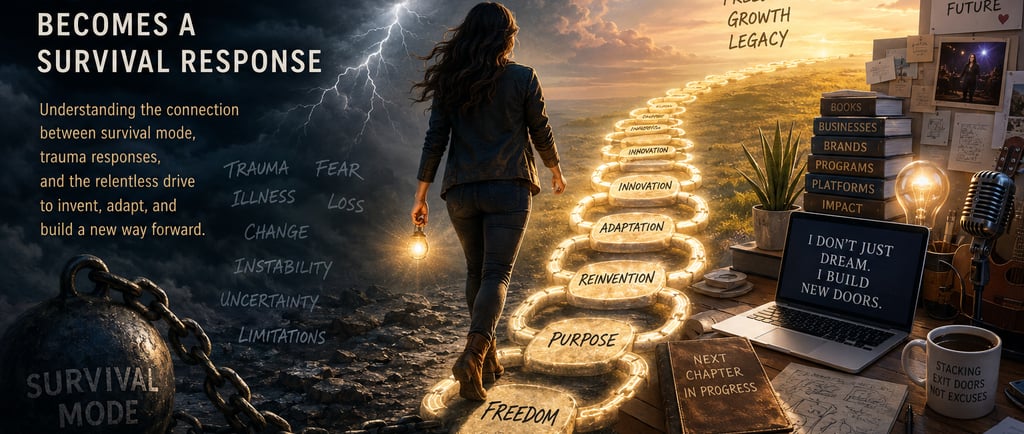
But if a person has lived through enough instability, loss, illness, danger, betrayal, poverty, displacement, or repeated disruption, the nervous system may begin treating stillness as unsafe.
For the chain-creator, stillness can feel like entrapment. Creation becomes movement. Creation becomes oxygen. Creation becomes “I am still here.”
The Difference Between Talent and Chain-Creation
Talent is capacity. Chain-creation is compulsion plus adaptation. Talent says: “I can do this well.” Chain-creation says: “I need to create another option.” Talent may improve a skill. Chain-creation builds entire survival systems.
Talent can exist inside one lane. A singer sings. A painter paints. A speaker speaks. A salesperson sells. A writer writes.
A chain-creator does not stay in one lane because the goal is not just expression. The goal is continuation.
That is why chain-creators often appear multi-talented, but “multi-talented” still does not fully explain them. Multi-talented people may have several abilities. Chain-creators connect those abilities into a sequence of survival moves.
They do not just have ideas. They convert ideas into pathways. That is why the word “chain” matters. A chain-creator creates links. When one link breaks, they build another. When one door closes, they invent another door. When their body fails, they create around the body. When society changes, they create around society. When the job disappears, they create another role. When the old identity no longer works, they create another version of themselves.
This is not random creativity. It is patterned adaptation.
My Own Realization: I Was Not Creating Just Because I Wanted To
I came to this conclusion by looking at the pattern of my own life.
I have always created. Books. Songs. Businesses. Coaching. Insurance. Entertainment concepts. Shows. Brands. Speaker messages. New identities. New income pathways. New ways to explain life. New ways to survive life. For years, I saw this as creativity, talent, intelligence, drive, or purpose. But then I looked closer. I did not only create when life was calm. I created when life cornered me.
When rheumatoid arthritis affected what I could physically do, I had to rethink work. I could not simply rely on the same body-based labor or the same physical capacity. So I created new ways to earn, think, speak, sell, coach, write, and build.
When COVID disrupted the entertainment world and changed the structure of what I had built, I had to adjust again. I could not keep living as though the world had not shifted. So I created new routes.
When I had a heart attack and faced death directly, life changed again. Survival was no longer an abstract idea. It became biological, spiritual, financial, emotional, and practical. After that, creating was not simply “art.” It was reconstruction.
This is how I recognized the truth: I do not create only because I love creating. I create because my nervous system learned that creation is how I do not get trapped. That realization changed everything. It explained why I could not simply “pick one thing.” It explained why I kept building new roles. It explained why I moved from one field to another when life, illness, trauma, or circumstance forced me to adapt. It explained why I do not just make art. I make exits. I make bridges. I make new rooms when the old room becomes too small to breathe in.
Scientific Support: Creativity Can Become Coping, Meaning-Making, and Growth
Research does not prove that every creative person is traumatized. It also does not prove that trauma automatically creates creativity. That would be too simple, and it would be false.
But research does support a meaningful relationship between adversity, trauma, coping, and creative expression.
Studies have documented links between adversity and creativity, especially when creativity is measured through actual creative behavior and accomplishment rather than vague personality labels. [4]
Research on post-traumatic growth also supports the idea that after disruption, some people experience changes in self-perception, priorities, meaning, and possibility. In some studies, post-traumatic growth has been linked with creative thinking and creative output, especially when people engage in deliberate reflection and rebuild a sense of agency. [5]
This is where chain-creation becomes more than a personal theory.
The evidence suggests that adversity can force a person to reorganize meaning. Creativity can become one way the brain and identity reorganize after rupture. In other words: Trauma can break the old map. Creativity can become the act of drawing a new one. For some people, that new map is a painting, a poem, or a song. For a chain-creator, the new map becomes an entire chain of reinventions.
The Creative Brain Under Stress
Stress affects creativity in complicated ways. It can restrict creativity when the brain is overwhelmed, exhausted, or locked into threat mode. Chronic stress can impair concentration, memory, emotional regulation, and cognitive flexibility. [6]
But the relationship between stress and creativity is not one-directional.
Creativity often requires two mental abilities: persistence and flexibility. Persistence helps a person stay with a problem. Flexibility helps a person generate new possibilities. Under certain conditions, pressure can intensify problem-solving because the person is not creating for entertainment. They are creating to resolve a threat.
That is the chain-creator’s zone. The question is not: “What would be fun to make?” The question is: “What can I build so I do not collapse here?” This is also why chain-creators can be misunderstood. People may say: “You do too much.” “You keep changing.” “Why can’t you just settle?” “Why are you always starting something new?” But from the inside, the answer is simple: Because the nervous system is scanning for safety. Because the old structure stopped working. Because survival required movement. Because creating the next thing was the only available form of flight.
My Sister’s Example: Survival Can Look Like Cleaning and Serving
This theory is not only about me. My sister’s trauma response looks different. Her survival pattern is cleaning and serving people. That does not mean she enjoys it. That does not mean it is her passion. That does not mean she exists to be used by others.
It means her nervous system learned that being useful, helpful, needed, and service-oriented could help her survive.
This connects to what trauma-informed language often calls the fawn response. Fawning is a survival strategy where a person appeases, pleases, serves, or accommodates others in order to reduce threat, avoid conflict, or stay emotionally safe. [7]
In some people, fawning looks like saying yes when they want to say no. In some people, it looks like over-apologizing. In some people, it looks like anticipating everyone’s needs before their own. In some people, it looks like cleaning the room so nobody gets upset. In some people, it looks like serving until they disappear. That is why it is dangerous to judge trauma responses from the outside. One person’s trauma response may look productive. Another person’s may look lazy. One may look generous. Another may look aggressive. One may look creative. Another may look controlling. But underneath, the same basic question may be running: “What do I need to do to stay safe?” My survival response became chain-creation. My sister’s became cleaning and serving. Neither pattern should be romanticized.
Both should be understood.
Chain-Creation Is Not the Same as Healing
This is where the conversation must be honest.
Just because a survival response produces something impressive does not mean the person is healed. A person can build a company while dysregulated. A person can write a book while grieving. A person can launch a brand while terrified. A person can serve everyone while emotionally abandoned. A person can clean the whole house while falling apart inside. Productivity is not proof of peace. Creation is not proof of regulation. Usefulness is not proof of joy.
This matters because society often rewards survival responses when they are profitable, attractive, or convenient.
If trauma makes someone overwork, society calls them disciplined. If trauma makes someone serve everyone, society calls them selfless. If trauma makes someone create nonstop, society calls them gifted. If trauma makes someone emotionally shut down, society calls them strong. But the nervous system knows the truth. The question is not only “What did you produce?” The question is “What were you trying to survive when you produced it?”
Why Chain-Creators Are Often Misread
Chain-creators are often mistaken for people who cannot commit.
But the truth may be that they are deeply committed to survival. They are not necessarily unstable. They are adaptive. They are not necessarily scattered. They are scanning. They are not necessarily addicted to newness. They may be allergic to entrapment. They are not necessarily avoiding work. They may be creating work that their body, mind, and circumstances can actually survive.
This is especially true for people whose lives have been shaped by illness, trauma, economic instability, caregiving, discrimination, grief, or repeated forced reinvention.
When a person’s life keeps removing options, the nervous system may develop a genius for manufacturing options.
That is chain-creation.
The Carfax: What the Evidence Supports
Here is what the research supports clearly:
First, fight-or-flight is real biology. The body responds to threat through nervous system activation, stress hormones, and survival-oriented changes in attention and energy. [1]
Second, trauma responses are varied. Fight and flight are not the only patterns. Freeze and fawn are also widely discussed in trauma-informed frameworks, and survival behavior can look like appeasement, people-pleasing, avoidance, hypervigilance, or compulsive action. [2,7]
Third, chronic stress affects the body and brain. The HPA axis and allostatic load research show that repeated stress responses can create cumulative strain. [3]
Fourth, adversity and creativity have a documented relationship, though it is complex. Trauma does not automatically create creativity, but creative activity can become a coping tool, a meaning-making process, and part of post-traumatic growth. [4,5]
Fifth, stress can both restrict and intensify creativity depending on context, intensity, personality, resources, and whether the person has enough safety to convert pressure into problem-solving. [6]
Sixth, entrepreneurship and self-employment are tied to stress, autonomy, adaptation, and physiological load. This matters because chain-creators often create jobs, businesses, platforms, and identities as survival strategies, not merely as career choices. [8] So no, the theory is not “just theory.” The specific term chain-creator may be new. But the ingredients behind it are research-supported: Survival response. Adaptive coping. Creative cognition. Post-traumatic growth. Stress physiology. Identity reconstruction. Meaning-making. Autonomy-seeking. Repeated reinvention under pressure. That is the foundation.
The Core Theory
A chain-creator is a person whose creative output forms a sequence of adaptive survival solutions.
They do not create one isolated product. They create linked pathways. They do not simply express imagination. They use imagination to prevent entrapment. They do not merely display talent. They convert pressure into possibility. They are not just “creative people.” They are survival architects.
Why This Matters
Understanding chain-creators matters because many people are praised for the very patterns that are exhausting them.
The goal is not to shame the pattern. The goal is to understand it. For me, understanding this gave language to my life. It helped me see that my constant creating was not random. It was not immaturity. It was not an inability to choose. It was not simply ambition.
It was my nervous system saying: “Build another way.” “Create another door.” “Do not get trapped.” “Survive this.” That realization does not make me less creative. It makes my creativity more honest. I am talented, yes. But talent alone does not explain me.
I am a chain-creator.
And I now understand why.