
Emotions Were Never the Enemy: Why We've Been Using Feelings All Wrong
For generations, we've been taught that emotions are signs of weakness, something to suppress, ignore, or "get over." But what if we've misunderstood them completely? In this article, Bianca Ocean Desmore challenges one of society's oldest misconceptions by explaining what emotions actually are, why they exist, and how learning to navigate them—not eliminate them—can transform every area of life. From the myth that women are more emotional than men to the difference between feeling and reacting, this article explores emotions through the lens of psychology, neuroscience, and practical self-awareness. Feelings aren't the problem. Uncontrolled feelings are.
Bianca (Ocean) Maria Desmore
7/23/20266 min read

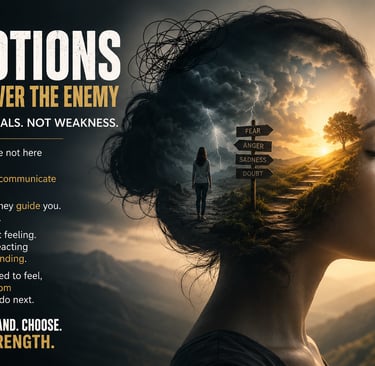
Emotions Were Never the Enemy
Emotions Were Never the Enemy: Why We Have Been Using Feelings All Wrong
Emotions have been part of human existence since the beginning of time. Why do we experience fear, happiness, anger, sadness, and distress? What causes the body to produce these feelings, and why have we decided that expressing them is somehow a sign of weakness?
One of the main things we need to establish is that emotions are not random inconveniences designed to interfere with rational thought. They are signals. They are part of the communication system the body uses to identify safety, danger, connection, loss, discomfort, and general distress.
It is my personal opinion that emotions have been misconceived, misinterpreted, and misunderstood for generations. Instead of being recognized as useful information, they have been treated as behavioral defects. People are taught to ignore them, suppress them, hide them, or apologize for having them in the first place.
I happen to believe that this approach has caused far more emotional instability than emotions themselves ever could.
The human body constantly collects information from its surroundings. It observes facial expressions, vocal tones, physical movements, and environmental changes before the conscious mind has had enough time to thoroughly evaluate what is happening. The body then responds by producing a sensation that encourages the person to pay attention.
We call that sensation an emotion.
Fear can indicate that the body has noticed a potential threat. Happiness can communicate safety, pleasure, or emotional connection. Sadness may indicate that something meaningful has been lost. Anger can reveal that a boundary has been crossed, an injustice has occurred, or an individual feels powerless in a particular situation.
At any rate, the emotion itself is not the problem. The issue begins when a person reacts to the emotion without taking the time to understand it.
For some reason, society has developed the idea that emotional people are weak people. I disagree with this belief wholeheartedly. Feelings are only weakness if uncontrolled. If a person is in charge of their feelings and does not immediately react to them, but instead evaluates them to identify what steps to take, then emotions would no longer be considered an issue.
They would become a tool.
There is a significant difference between feeling an emotion and allowing that emotion to control behavior. A person may feel angry without becoming aggressive. A person may experience fear without allowing it to dictate every decision. Someone can feel sadness without concluding that life has lost all meaning.
The emotion provides information. The person decides what to do with it.
Unfortunately, feelings have often been abused instead of utilized as a tool. Some people use emotions to manipulate others. Some use them as justification for harmful behavior. Others become so consumed by what they feel in the moment that they make permanent decisions based on temporary emotional conditions.
None of this proves that emotions are harmful. It proves that emotional navigation is essential.
Imagine that you are driving a vehicle and one of the warning lights appears on the dashboard. The light is not responsible for whatever is occurring inside the engine. It is simply notifying you that something may require attention. Covering the light with tape does not repair the vehicle. It merely removes the warning.
The same can be said about emotions.
Suppressing fear does not automatically remove danger. Ignoring sadness does not eliminate grief. Pretending not to feel anger does not resolve the violated boundary or personal frustration that caused it. The emotional signal may become quieter for a while, but the underlying issue remains.
This is why I believe the general rule should be simple. Feelings are only weakness if uncontrolled.
If a person learns how to pause, observe the feeling, determine what caused it, and evaluate the most appropriate response, then emotions become part of rational decision-making rather than the enemy of it.
While some believe that logic requires the absence of emotion, I believe logic is strengthened by emotional awareness. A person who understands their emotional reaction has access to more information than someone who simply refuses to acknowledge it.
Logic can evaluate the circumstances, but emotion can reveal what those circumstances mean to the individual.
For instance, a person may logically understand that a relationship is unhealthy, but fear may reveal why they remain in it. Another person may know that a job is financially beneficial, while emotional distress communicates that the environment is harmful to their well-being. Someone may recognize that a family member is behaving unfairly, while guilt prevents them from establishing boundaries.
In each of these situations, the emotion offers information that logic alone may not explain.
The answer is not to obey every feeling. The answer is to examine it.
At any rate, there is another belief regarding emotions that needs to be addressed. The stigma that women are more emotional than man is FALSE!
Men experience emotions in the same way women do. They just navigate them differently.
A woman is more likely to harvest emotions unintentionally and express them with words and crying, while a man is more likely to decompress them and express them in anger and radical behavior. Both of these behaviors are unfavorable.
Society has somehow decided that crying is an emotional response while anger is not. I have never understood this reasoning. Anger is an emotion. Aggression is often driven by emotion. Withdrawal can be emotional. Reckless behavior can be emotional. Silence can be an emotional reaction, just as crying and verbal expression can be.
The method of expression may differ, but the emotional experience remains.
In my opinion, many men have not been taught to control emotions. They have been taught to disguise them. There is a difference.
Telling a boy not to cry does not teach him how to evaluate sadness. It teaches him that sadness is unacceptable. Telling him to be strong does not explain what strength should look like when he is hurt, afraid, ashamed, or overwhelmed.
As a result, the emotion does not disappear. It is simply redirected.
Some men redirect emotional distress into anger, aggression, silence, substance use, impulsive decisions, or reckless behavior. Society may not label these actions as emotional because they do not involve crying or verbal vulnerability, but they are often emotional reactions nonetheless.
Women, on the other hand, are generally permitted to express sadness more openly, but they are frequently criticized for doing so. They are labeled dramatic, unstable, sensitive, or difficult when they communicate emotional distress.
Neither response is beneficial.
Women should not be encouraged to remain trapped inside emotions, and men should not be encouraged to pretend they do not have them. Both need to learn how to recognize, interpret, and control emotional responses.
The issue has never been whether men or women feel more.
The issue is how they have been conditioned to express what they feel.
I believe emotional control begins with observation. A person should be able to acknowledge an emotion without immediately turning it into an action. Feeling angry does not require yelling. Feeling hurt does not require retaliation. Feeling afraid does not require avoidance. Feeling rejected does not require begging for acceptance or punishing the person responsible.
The feeling should raise a question. Why am I feeling this? What occurred before the emotion appeared?
Is the feeling based on what is happening now, or is the current situation reminding me of something that happened in the past?
Does this emotion require action, reflection, communication, or simply time?
These are far more useful questions than asking whether the person should be feeling the emotion at all.
Ideas and internal reflections, as well as physical sensations from the outside world, should be evaluated, not condemned.
How are we to evolve emotionally if we continue teaching people that strength means emotional silence? How can we expect individuals to make healthy decisions if they have never been taught to understand the signals their own bodies are sending?
We are eager to teach professional skills, academic theories, and technological advancement, but emotional navigation is often treated as though it should develop automatically.
It does not.
Emotional control is a learned skill. It requires awareness, practice, honesty, and personal responsibility. A person must be willing to recognize that an emotion is present without allowing it to become an excuse for destructive behavior. That is where true strength begins.
Strength is not the absence of fear. It is the ability to evaluate fear before making a decision. Strength is not pretending anger does not exist. It is the ability to understand the anger without becoming harmful. Strength is not refusing to cry. It is knowing that crying does not remove personal authority.
Emotions are needed to exist. How to control and navigate them is essential.
Philosophical and emotional innovation is only possible if we recognize the current flaws in the way feelings are perceived and pivot.
We cannot continue using centuries-old beliefs about weakness, masculinity, femininity, and self-control to explain emotional behavior in modern society. Human beings have evolved technologically, academically, and socially, but our understanding of emotion remains remarkably primitive.
The body communicates through emotion for a reason. It warns, protects, connects, and informs. The emotion should be heard, but it should not be placed in charge.
Perhaps emotions were never the enemy.
Perhaps the real issue has always been that no one taught us how to use them.