Stop Sugar-Coating Suffering: Healing Begins When Excuses End
Mental health diagnoses should explain your struggles—not define your future. Discover why healing requires honesty, accountability, and addressing the root cause instead of settling for labels and excuses.
Bianca (Ocean) Maria Desmore
7/24/20265 min read
Stop Sugar-Coating Suffering: Healing Begins When Excuses End
We have become a society that is incredibly good at talking about our struggles and surprisingly bad at doing something about them. Over the past several years, I've noticed something that should concern all of us. Conversations about ADHD, anxiety, depression, trauma, and countless other mental health challenges have shifted. Instead of asking, "How do I heal?" many conversations have turned into, "Here's why I can't." Somewhere along the way, diagnosis became identity, and explanation became permission to stop moving forward. That statement will upset some people, and I'm okay with that, because if the goal is healing, then honesty has to matter more than comfort.
Let me be crystal clear before someone misinterprets what I'm saying. Mental health challenges are real. Trauma is real. Anxiety is real. ADHD is real. Depression is real. I have spent years studying human behavior and working with people who have experienced unimaginable pain. I have watched people fight battles most of us will never fully understand. This isn't about pretending those challenges don't exist. It's about asking one simple question that far too many people never ask: Now what?
Instead, many people become trapped in what I call the Avoidance Dance. The Avoidance Dance is what happens when talking about the challenge slowly replaces working on the challenge. Every conversation reinforces the identity. Every social media post gains sympathy. Every new explanation feels validating. Before long, the diagnosis isn't simply something you have—it becomes who you are. Most people don't even realize it's happening.
I don't believe the majority of people intentionally choose to stay stuck. I believe they stay there because it has become familiar. Human beings naturally gravitate toward certainty, even when that certainty is painful. If you've spent years hearing, "Well, that's just your anxiety," or, "You have ADHD, so of course that's difficult," eventually your brain stops seeing those statements as temporary obstacles and starts accepting them as permanent facts. What once explained your struggle slowly becomes the story you tell yourself about who you are.
Unfortunately, society doesn't always help. We've become so afraid of offending people that we've started confusing compassion with enabling, and those two things are not even remotely the same. Compassion says, "I understand this is difficult. Let me help you move forward." Enabling says, "This is difficult, so you never have to move." One empowers people. The other quietly teaches them to stay exactly where they are.
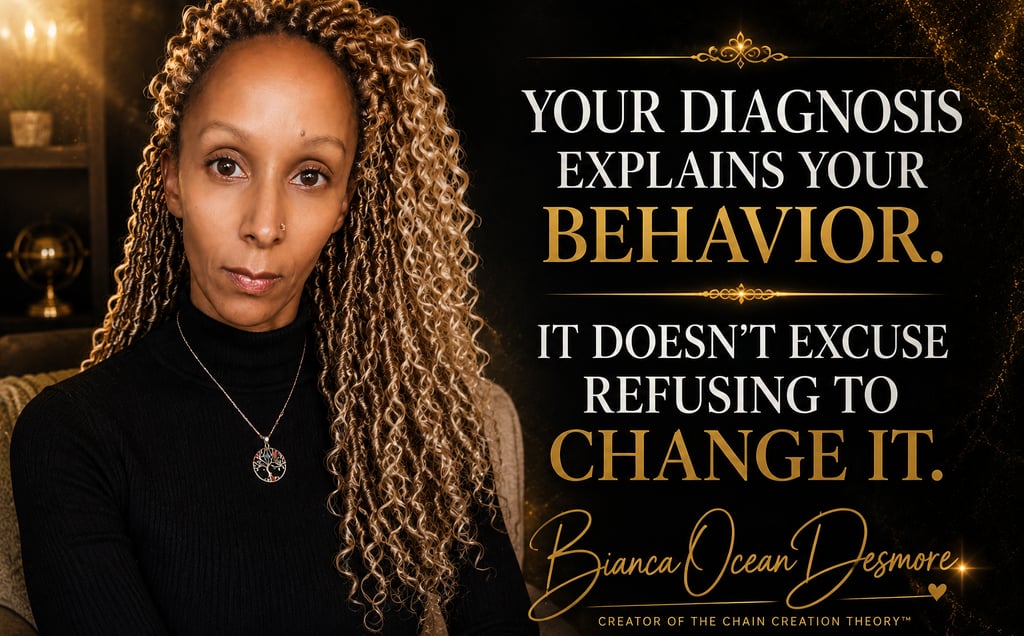
At some point, we have to stop normalizing every excuse simply because we attached a label to it. A diagnosis should explain your experience. It should never become permission to surrender your future. Labels can provide understanding, but they should never become a life sentence.
One of the biggest misconceptions I encounter is the belief that medication is always the first—or only—answer. Let me be equally clear here. Medication absolutely has its place. It saves lives. It helps people function. Some people genuinely need it, and there should be absolutely no shame in taking medication when it's medically appropriate. However, I also think we ask far too few questions before we reach for it. Have we addressed the underlying trauma? Have we examined the beliefs driving the behavior? Have we looked at the nervous system? Have we identified unhealthy coping mechanisms? Have we challenged the patterns that have been repeating for years? Have we explored whether the brain simply learned survival instead of safety?
Because if we haven't asked those questions, then we've skipped an enormous amount of work that could genuinely change someone's life. Freedom deserves a chance before dependency becomes the only option. That isn't anti-medication. It's pro-healing.
This is exactly why I work differently than many coaches. I don't believe in one-size-fits-all coaching. I don't believe everyone should follow the same five-step morning routine, repeat identical affirmations, or force themselves through someone else's formula. Human beings are far too complex for cookie-cutter solutions. Every person sitting across from me has lived a different life, experienced different relationships, developed different fears, and learned different survival strategies. Why would I assume they all need the exact same answer?
When someone comes to me, I don't immediately start giving advice. I start asking questions—real questions, sometimes uncomfortable questions, and often questions people have never been asked before. I'm not interested in putting a motivational bandage over a lifelong behavioral pattern. I'm interested in understanding how that pattern developed in the first place. If someone tells me they're anxious, I don't automatically assume anxiety is the real problem. I want to know what created it. If someone tells me they struggle with confidence, I'm not interested in handing them twenty affirmations to repeat in front of a mirror. I want to know who convinced them they weren't enough. If someone tells me they keep sabotaging relationships, I don't immediately start teaching communication skills. I first want to understand why their nervous system believes love requires self-protection.
Because until we identify the root, we're usually treating symptoms. Symptoms have an annoying habit of disappearing for a while, only to return wearing different clothes. That's why so many people feel like they're making progress one month and starting over the next. The visible problem changes, but the underlying pattern remains untouched.
I've had conversations with clients where they expected sympathy and instead received honesty. Not cruelty. Not judgment. Honesty. Sometimes honesty sounds like, "No, I don't think that's actually your problem." Sometimes it sounds like, "I think you're protecting a belief that no longer serves you." Sometimes it sounds like, "You've become so accustomed to surviving that you've forgotten what living actually feels like." Those conversations aren't always comfortable, and they're not supposed to be. Growth rarely begins inside your comfort zone.
Here's something else I've learned after years of working with people. Most people don't actually need someone to tell them they're broken. They've already heard that enough. What they need is someone willing to tell them they're capable of more than the story they've been repeating. There is an enormous difference between validating someone's pain and validating their limitations. I will always validate pain. I refuse to validate permanent helplessness.
I've watched people overcome things they once believed were impossible. I've watched people retrain destructive thought patterns, heal relationships they thought were beyond repair, and finally step out of survival mode after years of believing that was simply who they were. None of it happened overnight, and none of it happened because someone told them to "just think positive." It happened because they became willing to do the difficult work of identifying the real issue instead of endlessly discussing the visible one.
Healing isn't easy. It requires honesty, accountability, consistency, patience, and sometimes tears. It requires uncomfortable conversations and the willingness to admit that you've been protecting beliefs that have quietly been controlling your life for years. That's difficult work, but difficult doesn't mean impossible.
Here's the beautiful part. Healing is possible. More possible than many people have been led to believe. You are probably not lazy. You're probably not weak. You're probably not beyond hope. You're probably a remarkably capable person whose brain learned a survival strategy that no longer serves you. The encouraging news is that if your brain learned it, your brain can learn something different. That takes work. It takes persistence. It takes courage. But it can absolutely be done.
The world doesn't need more people collecting labels like trophies. It needs more people collecting evidence that healing is possible. Your diagnosis may explain where you are today, but it should never be allowed to decide where you stay tomorrow.