
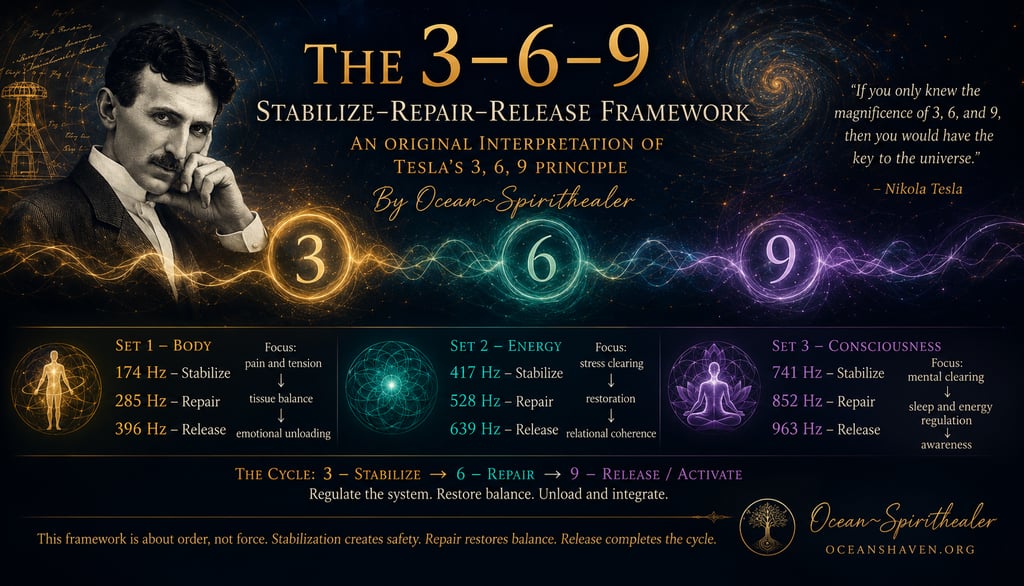
The 3–6–9 Stabilize–Repair–Release Framework An Original Interpretation of Tesla's 3, 6, and 9 Principle
What if we've misunderstood Tesla's famous 3, 6, and 9 quote? In this article, I share the beginning of my journey into an original interpretation inspired by Tesla's work on energy, vibration, and mathematics. Instead of focusing on modern manifestation techniques, I explore a recurring mathematical pattern hidden within the Solfeggio frequencies that ultimately led me to develop the 3–6–9 Stabilize–Repair–Release Framework. Whether you agree with my conclusions or not, I invite you to follow my reasoning and decide for yourself.
Bianca (Ocean) Maria Desmore - Creator of The Chain Creation Theory™
7/21/20264 min read
Part 1: The Question That Wouldn't Leave Me Alone
Nikola Tesla is often quoted as saying, "If you only knew the magnificence of 3, 6, and 9, then you would have the key to the universe." Whether those were his exact words or a paraphrased version that has evolved over time isn't the purpose of this article. What matters is that the statement has become one of the most repeated quotes attributed to one of history's greatest inventors, and with that popularity has come countless interpretations.
Over the past several years, one interpretation has dominated social media. According to thousands of videos, books, and online discussions, Tesla was supposedly referring to a manifestation technique where you write your desire three times in the morning, six times in the afternoon, and nine times at night until the universe eventually delivers what you asked for. The method has become so widespread that many people now associate the numbers three, six, and nine almost exclusively with manifestation.
Personally, I've never been convinced.
Before anyone misunderstands me, let me be clear. I have absolutely no issue with writing down goals. In fact, I think it can be incredibly beneficial. Psychology has demonstrated for decades that writing down goals improves focus, strengthens commitment, and increases the likelihood that people will notice opportunities aligned with those goals. When you repeatedly direct your attention toward something important, your brain naturally begins looking for evidence and opportunities connected to it. That isn't magic. That's attention, behavior, and neuroscience working together.
But that's a very different claim from suggesting that Tesla's famous statement was simply an instruction to write our wishes in a notebook. In my opinion, those are two entirely different conversations.
Tesla dedicated his life to understanding electricity, resonance, vibration, mathematics, energy, and natural law. His inventions literally changed the world. Alternating current, wireless energy experiments, radio technology, high-frequency electrical systems, resonant transformers, and countless other innovations all came from a man who viewed the universe through the language of mathematics and energy. Everything we know about Tesla suggests he searched for patterns, relationships, and principles that governed how nature worked.
Because of that, I have always struggled with the idea that the "key to the universe" was simply writing your desires eighteen times a day. Could I be wrong? Absolutely.
None of us can sit down with Tesla and ask him exactly what he meant. Everything written about this quote is, to some extent, interpretation. The difference is that I want to explain how I arrived at mine rather than simply repeating what someone else has already said.
The more I thought about it, the more one question continued to surface. What if everyone was looking in the wrong place? What if the numbers themselves weren't the message? What if the pattern behind those numbers was?
That question stayed in the back of my mind for quite some time. Eventually, curiosity got the better of me. Instead of continuing to debate what Tesla may or may not have meant, I decided to look at something tangible. If Tesla devoted his life to studying frequency and vibration, perhaps I should start there as well.
That decision eventually led me to the Solfeggio frequencies.
Like many people, I had heard of them years earlier. They are commonly discussed within wellness communities and are often associated with various emotional, physical, or spiritual benefits. Whether every claim made about these frequencies has been scientifically validated is still a matter of debate, and that isn't the purpose of this article. What interested me wasn't whether every claim was true. What interested me was the structure.
The frequencies themselves were familiar.
174 Hertz.
285 Hertz.
396 Hertz.
417 Hertz.
528 Hertz.
639 Hertz.
741 Hertz.
852 Hertz.
963 Hertz.
Most conversations stop right there. People memorize which frequency is believed to help with pain, which one supposedly promotes healing, and which one is associated with love, intuition, or emotional release. They listen to the frequencies, recommend playlists to friends, and move on.
I found myself asking a different question.
Why these numbers?
Why not 175? Why not 300? Why not 550?
Was there any mathematical relationship connecting them, or were they simply individual frequencies that happened to be grouped together?
Out of curiosity, I did something incredibly simple.
I added the numbers together.
That probably sounds almost disappointingly basic, but sometimes the simplest questions produce the most interesting observations.
The first frequency was 174 Hertz.
1 + 7 + 4 = 12
1 + 2 = 3
Interesting.
The second frequency was 285 Hertz.
2 + 8 + 5 = 15
1 + 5 = 6
Even more interesting.
The third frequency was 396 Hertz.
3 + 9 + 6 = 18
1 + 8 = 9
At first, I honestly didn't think much of it. My immediate reaction wasn't, "I've discovered something." It was, "Well...that's a neat coincidence."
Coincidences happen.
The human brain is exceptionally good at finding patterns, even when they don't actually exist. Psychologists have studied this tendency extensively. We naturally search for meaning because recognizing patterns has always been an important survival advantage. Sometimes those patterns are real. Sometimes they aren't. I didn't want to fool myself. So instead of jumping to conclusions, I decided to look at something else entirely. I went back and looked at what those three frequencies were traditionally associated with.
The first frequency, 174 Hertz, is commonly associated with relieving physical pain and promoting a sense of stability within the body.
The second frequency, 285 Hertz, is generally associated with tissue repair, recovery, and restoration.
The third frequency, 396 Hertz, is commonly linked to releasing fear, guilt, and emotional burdens.
That's when my perspective shifted. I stopped looking only at the mathematics. I started looking at the sequence.
Pain relief.
Healing.
Release.
The order itself caught my attention.
If someone experiences a physical injury, the first priority is usually reducing immediate distress and stabilizing the situation. Once stability has been established, repair can begin. Only after healing progresses can the body gradually return to normal function.
The same basic progression often appears emotionally as well. Before someone can truly let go of emotional burdens, they generally need a sense of safety and stability. Once that stability exists, healing becomes possible. As healing occurs, emotional release naturally follows.
Whether we're discussing the body or the mind, the progression seemed surprisingly consistent.
First stabilize.
Then repair.
Then release.
At that point, I still wasn't convinced I'd found anything significant.
One set of three frequencies following that progression could easily be coincidence.
The real question was whether the pattern would continue.
So I moved on to the next three frequencies...