The Nervous System, Survival Mode, and Chain Creation Theory™
What if your endless need to create, achieve, learn, and reinvent yourself isn't ambition at all? In this groundbreaking article, Bianca Ocean Desmore explores the science of the nervous system, survival mode, and the foundations of Chain Creation Theory™, a new framework that proposes some people create not from inspiration, but from a subconscious search for safety.
CHAIN CREATION THEORY™
Bianca (Ocean) Maria Desmore
6/24/20265 min read
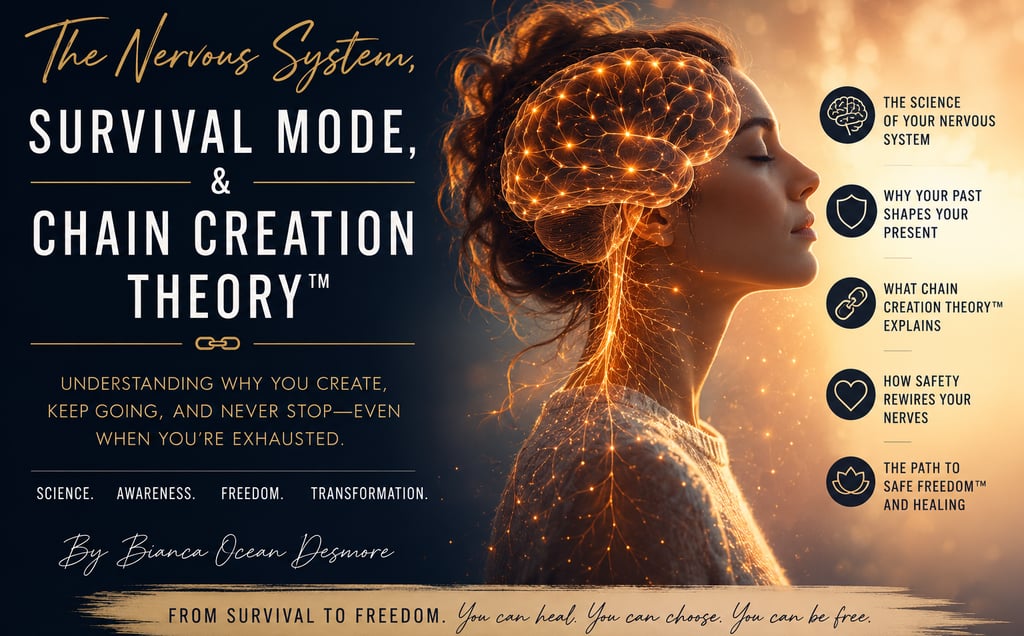
The Nervous System, Survival Mode, and Chain Creation Theory™
By Bianca Ocean Desmore
What Is the Nervous System?
The nervous system is the body's communication network. It is responsible for collecting information, processing experiences, and directing how we think, feel, react, and behave.
Every thought, emotion, memory, sensation, fear, and decision travels through the nervous system.
Without it, we could not move, learn, remember, or survive.
The nervous system consists of two primary parts:
The Central Nervous System (CNS)
The central nervous system includes:
• The brain
• The spinal cord
Its primary role is to receive information, process it, and coordinate responses throughout the body.
The Peripheral Nervous System (PNS)
The peripheral nervous system includes all the nerves extending from the brain and spinal cord into the body.
Its job is to deliver messages between the brain and every organ, muscle, and tissue.
Together, these systems create the foundation of human experience.
The Autonomic Nervous System
Within the nervous system is a powerful automatic operating system known as the Autonomic Nervous System.
This system regulates:
• Heart rate
• Blood pressure
• Breathing
• Digestion
• Hormone release
• Stress responses
Most of these functions occur automatically without conscious thought.
The autonomic nervous system contains two primary branches.
The Sympathetic Nervous System
This is commonly known as the survival system.
When danger is detected, the sympathetic nervous system activates the body's emergency response.
This includes:
• Fight
• Flight
• Freeze
• Fawn
When activated:
• Heart rate increases
• Muscles tighten
• Stress hormones rise
• Attention narrows
The body prepares for survival.
The Parasympathetic Nervous System
This is often referred to as the recovery system.
It supports:
• Healing
• Digestion
• Creativity
• Learning
• Connection
• Rest
When the parasympathetic nervous system is active, the body feels safe enough to repair and restore itself.
Why Childhood Experiences Matter
The nervous system learns through experience.
When a child repeatedly experiences:
• Criticism
• Rejection
• Instability
• Neglect
• Emotional abuse
• Physical abuse
The nervous system begins adapting to those conditions.
Its primary goal becomes protection.
The challenge is that the nervous system often responds to emotional threats the same way it responds to physical threats.
To the nervous system: Rejection can feel dangerous. Failure can feel dangerous. Embarrassment can feel dangerous. Even success can feel dangerous if success once resulted in punishment, criticism, jealousy, or loss. The nervous system does not ask whether a belief is logical. It asks whether it feels safe.
What Science Says About Survival Mode
Research in neuroscience and psychology shows that chronic stress can alter both brain function and behavior.
When the nervous system remains in a prolonged state of activation:
• Cortisol levels remain elevated
• The amygdala becomes more reactive
• Emotional regulation becomes more difficult
• Decision-making becomes impaired
• Threat detection increases
• The body prioritizes survival over growth
In simple terms, the nervous system becomes focused on staying safe rather than thriving.
This condition is commonly referred to as living in survival mode.
Where Chain Creation Theory™ Begins
This is where current neuroscience ends and Chain Creation Theory™ begins.
While science has extensively documented trauma responses, nervous-system dysregulation, behavioral conditioning, and survival mechanisms, Chain Creation Theory™ proposes a specific explanation for a behavior that many high-achieving individuals display throughout their lives.
According to Chain Creation Theory™, some people do not continuously create because they are simply ambitious.
They create because their nervous system has learned that creating feels safer than stopping.
The theory proposes that unresolved survival responses can drive individuals to repeatedly:
• Start businesses
• Learn new skills
• Write books
• Change careers
• Build projects
• Reinvent themselves
• Pursue new opportunities
This repeated pattern is known as Chain Creation™. Individuals who display this pattern are referred to as Chain Creators™. According to the theory, the behavior is not necessarily driven by inspiration alone. It may be driven by the nervous system's search for safety. The next project feels safer than stillness. The next goal feels safer than rest. The next achievement feels safer than receiving. The next reinvention feels safer than simply being. From the outside, a Chain Creator™ often appears highly ambitious. According to Chain Creation Theory™, the nervous system may actually be responding to unresolved insecurity, instability, fear, or past conditioning.
The Difference Between Talent and Chain Creation™
One of the most important distinctions proposed by Chain Creation Theory™ is the difference between talent and survival-driven creation.
Talent creates because it wants to express itself. Chain Creation™ creates because it believes it must.
Talent says:
"I want to create."
A dysregulated nervous system says:
"I need to create."
One is driven by inspiration. The other is driven by survival. Both can produce extraordinary accomplishments. Only one produces lasting peace.
Why Success Often Doesn't Solve The Problem
Many Chain Creators™ believe:
"When I make enough money, I'll finally feel safe."
"When I become successful, I'll finally relax."
"When I achieve enough, everything will change."
Yet many discover that success provides only temporary relief.
Why? Because safety is not generated by achievement. Safety is generated by the nervous system.
If the nervous system never learns safety, it simply creates another goal, another project, another business, another challenge. The cycle continues. Not because the person failed.
Because the nervous system never received evidence that it was safe to stop.
Can The Nervous System Be Reset?
The term "nervous system reset" has become popular.
Scientifically speaking, the nervous system is not reset like a computer. Instead, it is retrained.
The brain possesses a remarkable ability called neuroplasticity.
Neuroplasticity refers to the brain's ability to form new neural pathways and learn new patterns throughout life. This is how healing occurs. The nervous system gradually learns that what once felt dangerous is no longer dangerous.
What Actually Heals The Nervous System?
Current science points toward a common underlying mechanism:
Repeated experiences of safety. Not positive thinking alone. Not affirmations alone. Not motivation alone. Not willpower alone. The nervous system changes when it repeatedly experiences situations that once felt threatening and discovers they are now safe.
For example:
A person speaks up for themselves. Nothing bad happens.
The nervous system learns.
A person receives money without guilt. Nothing bad happens.
The nervous system learns.
A person sets a boundary. Nothing bad happens.
The nervous system learns.
A person allows themselves to rest. Nothing bad happens.
The nervous system learns.
Over time, the brain updates its predictions. Safety begins by replacing fear.
The nervous system recalibrates.
Safe Freedom™
Safe Freedom™ is a practical application that aligns closely with this understanding of nervous-system healing. Safe Freedom™ is the deliberate practice of allowing yourself to become yourself in small, manageable ways. One truth. One choice. One boundary. One act of receiving. One act of authenticity. At a time.
Each experience teaches the nervous system a new lesson:
"I can be myself and still be safe."
For many people, this may be the lesson their nervous system has been waiting to learn for decades.
The Future of Chain Creation Theory™
If Chain Creation Theory™ proves correct, then the solution is not teaching people how to create more.
Many Chain Creators™ already create constantly. The solution is teaching them how to feel safe. Because once safety is established, creation changes. It is no longer driven by fear. It becomes driven by purpose. The goal is not to stop creating. The goal is to stop creating because you are afraid not to. The goal is to become free enough to choose. And perhaps that is the true difference between surviving and living.
Related Topics
Chain Creation Theory™
Chain Creator™
Survival Mode
Nervous System Healing
Safe Freedom™
Remember Your Future And Create It
Bianca Ocean Desmore